
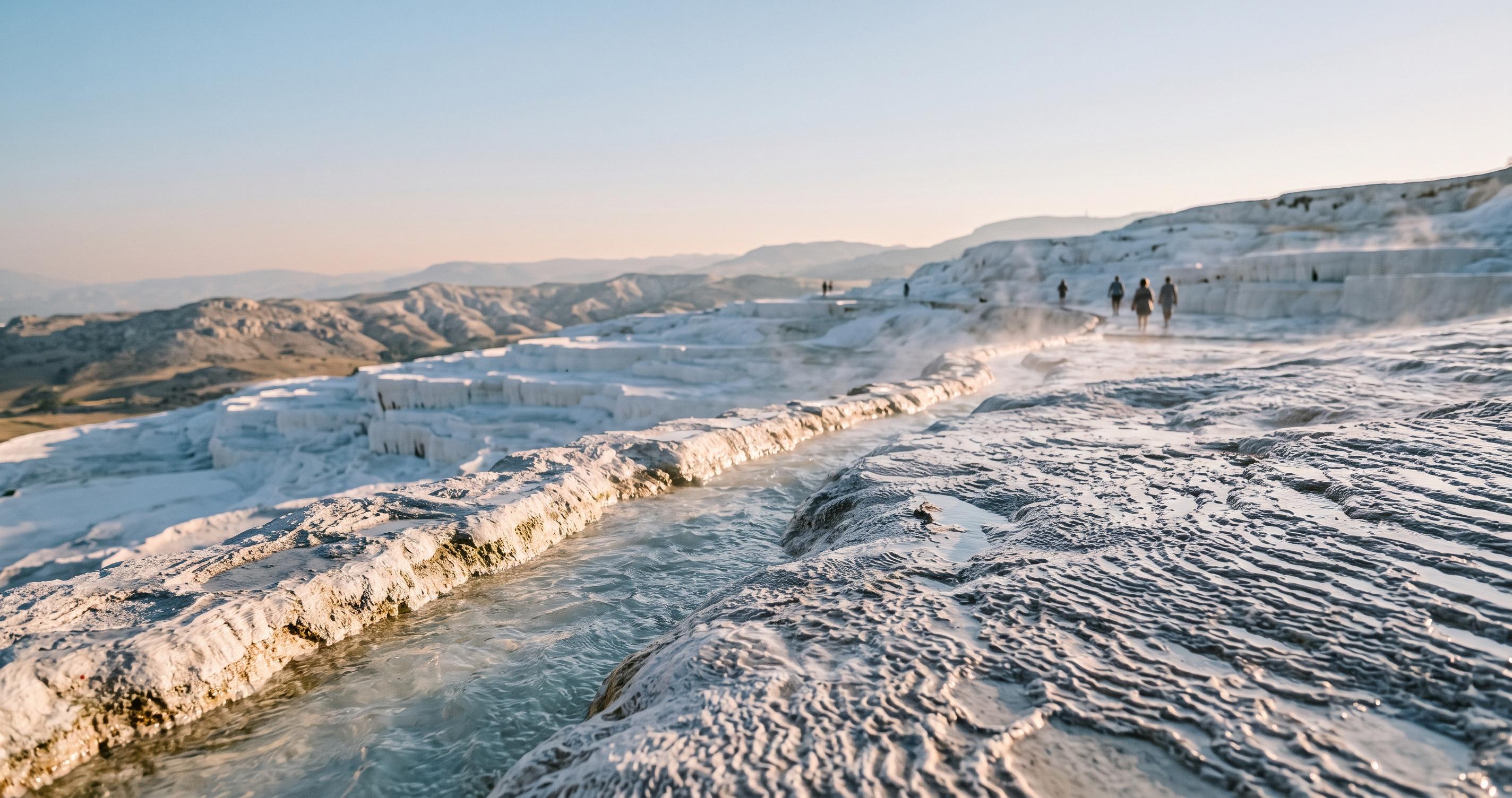
The photographs of Pamukkale leave out the two things that define an actual visit. You are barefoot, and the water is much shallower than it looks.
Neither is a problem. Both are worth knowing before you are standing at the bottom of the hill holding your shoes and wondering what happens next.
Why the shoes come off
The terraces are still forming. Mineral-rich water leaves calcium carbonate behind as it cools, and the white surface you are walking on is that deposit, soft in places and actively building in others. Footwear scuffs it, and boot treads carry in grit and dirt that stain a surface whose whole appeal is that it is white.
So the barefoot rule is practical rather than ceremonial. It is the reason there is still something here to walk on. There is a designated route, and the sections either side of it are closed and rotated so worn areas can recover.
This also means the site does not look identical to the photograph you saw. Some basins will be full, others dry chalk, and which ones changes through the year. Nobody can promise you a specific pool.
What it actually feels like underfoot
The surface is not smooth. It is ridged and slightly granular, closer to coarse chalk than to tile, and in most places that texture gives you reasonable grip even wet.
Where it gets awkward is the smoother, flatter stretches with a film of water running over them. Those are slick, and the natural response of hurrying across is the wrong one. Short steps, flat foot, no rush.
Some people find the texture mildly uncomfortable after a while, in the way a pebble beach is uncomfortable: not painful, just insistent. If your feet are sensitive, know that this is a sustained walk rather than a quick crossing.
The water is warm where it emerges near the top and progressively cooler as it spreads down the hillside. On a hot day that is pleasant at the bottom and slightly surprising at the top. In cold weather it inverts what you would expect, with warm water, cold air, and steam coming off the surface.
How deep it is
Ankle to knee, and no more than that.
This is the most common wrong expectation about Pamukkale. People arrive intending to bathe in those blue-white pools on the hillside and find they can barely sit down in them. The terraces are for wading, not swimming.
The place you can swim is the Ancient Pool up on the plateau, thermal water with fallen marble columns lying in it, reopened after restoration in 2026. If swimming is part of why you came, that is where it happens, and you should plan for it rather than discover it.
The glare is the real difficulty
An unshaded white surface reflecting midday sun is harder work than the temperature suggests. It tires your eyes, it burns the underside of your chin and nose in ways people do not anticipate, and it makes the middle of the day the worst window for a walk you want to enjoy.
Sunglasses matter more here than almost anywhere else you will go in Türkiye. So does a hat. So does putting sunscreen somewhere you would not normally bother with, because the light is coming up at you as well as down.
Early morning and late afternoon are not only cooler. They are visually kinder, and the low angle picks out the rims of the basins in a way that flat overhead light flattens completely.
What to bring
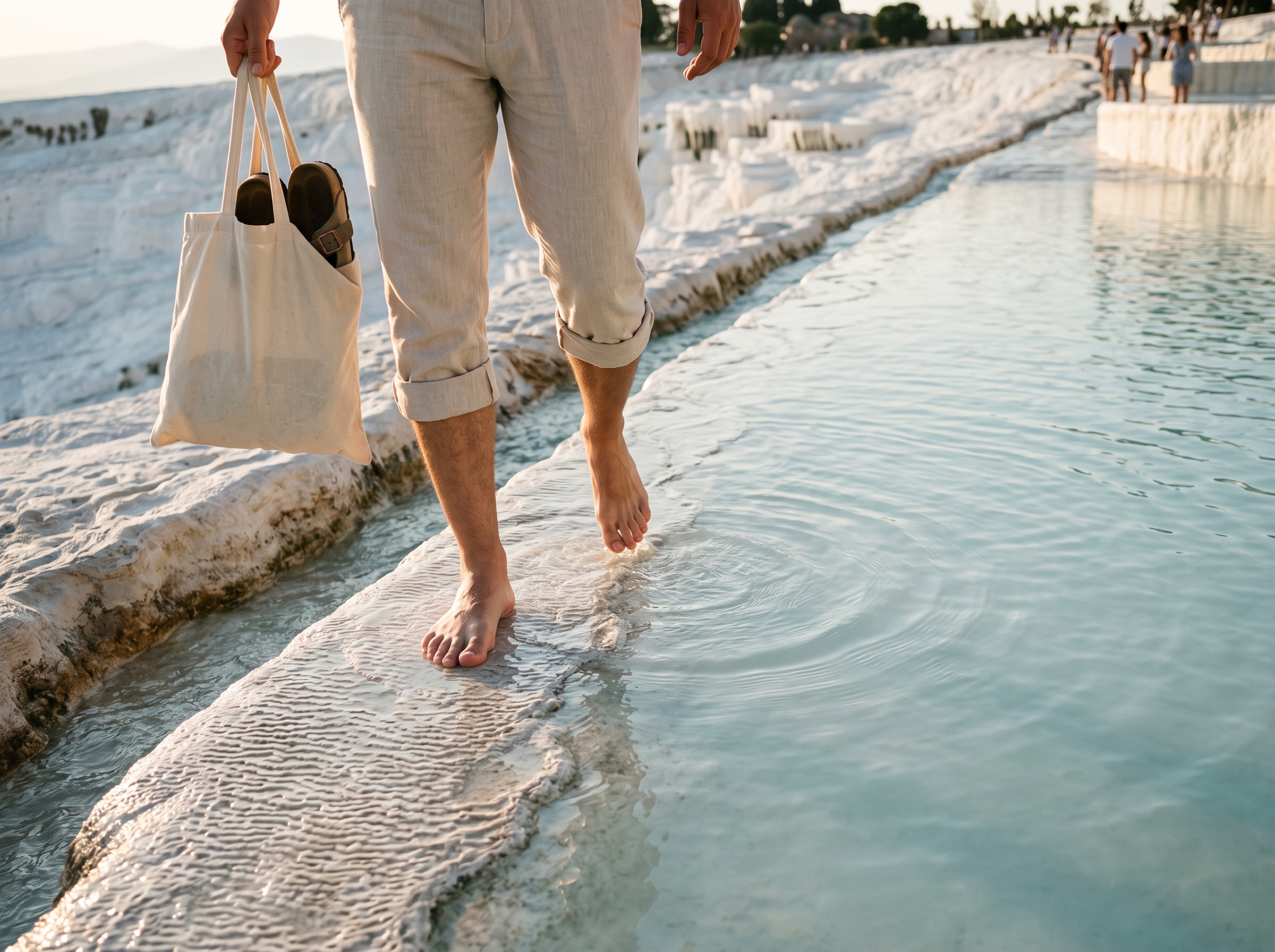
A bag for your shoes is the one thing you should not skip, because you carry them the whole way and there is nowhere to leave them. Doing this one-handed with a phone out does not work.
Take a towel if you plan to be in the water at all, since feet dry slowly on a walk that continues afterwards. Wear something you can roll up, because trousers get wet at the hem more often than people expect: the walkable channel is exactly where the water runs.
Otherwise, carry less than you think. Everything you bring is on your back or in your hands for the duration.
Who finds this hard
The site is often sold as effortless, so this is worth saying plainly.
Uneven, wet, mildly abrasive ground on a slope is difficult for anyone with balance problems, weak ankles or foot pain. It is difficult in a different way with small children, who move faster than their grip allows. Doing it uphill in strong heat is tiring even for people who walk a lot.
None of that makes it off-limits, and plenty of people in all those categories do it and are glad they did. But if it applies to someone in your group, enter from the plateau above and walk down rather than up. Same site, much less work.
What the photographs do not show
The classic viewpoint is busy, and everyone there is queuing for a version of the same frame. If you want the hillside without people in it, that is an early-morning proposition rather than a matter of finding a better angle.
Photographs also flatten the scale. From a distance the terraces look delicate, almost miniature. Standing in them, the basins are broad and the drop between levels is more substantial than the pictures suggest. It is a bigger and rougher place than its own postcard, which is mostly a good thing: you stop looking for the photograph and start noticing what is underfoot.