
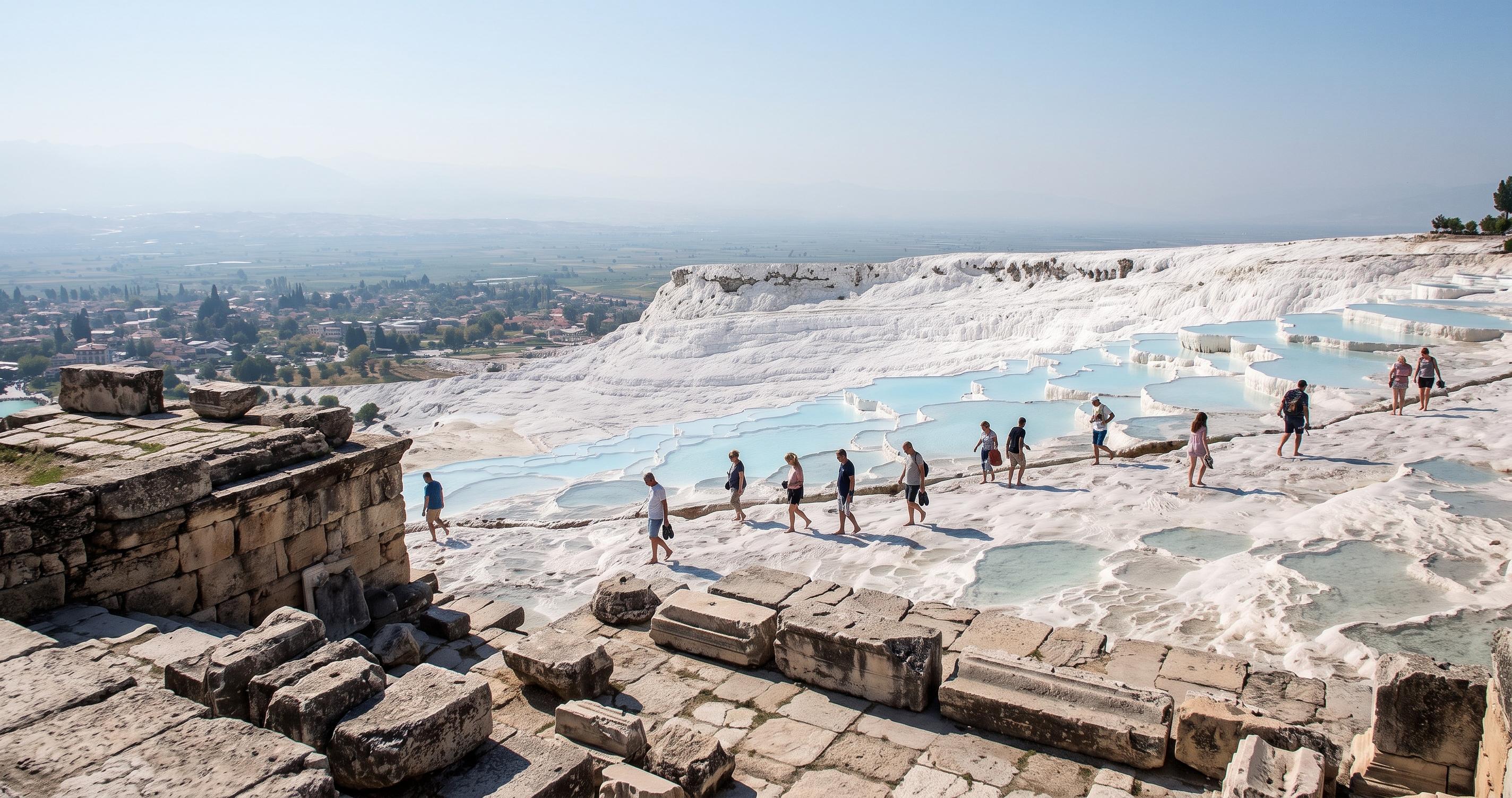
Most people who visit Pamukkale see about half of it.
They walk the white terraces, take the photograph everyone takes, and leave without ever going up onto the plateau, where a full Roman city sits among the springs that made the terraces in the first place. The terraces and Hierapolis are not two attractions near each other. They are one site, and the ruins are the reason it is listed rather than merely admired.
One day is enough for both, provided it is sequenced properly.
First, understand the shape of the place
The thermal springs rise on a plateau. Their mineral-heavy water spills over the edge and down the hillside, and as it cools it leaves calcium carbonate behind. Centuries of that produced the white terraces you have seen in photographs.
The ancient city was built up top, around the source. So the geography is simple: terraces on the slope, city on the plateau above them. Everything about planning the day follows from that one fact.
The decision nobody knows they are making
There is an entrance at the bottom, in the town, and there are gates up on the plateau. Which one you use decides your entire visit, and most visitors discover this only when the coach parks.
Going from the bottom upwards means you do the barefoot terrace climb first, on the designated route, and arrive at the ruins having already seen the headline. This is the version with a sense of arrival, because the terraces reveal themselves gradually as you rise and Hierapolis appears as a reward rather than an obligation. It is also the harder version: uphill, barefoot, on wet mineral stone, with the white surface throwing sun back at you the whole way.
Starting on the plateau and working down means you walk the city while you are fresh and descend the terraces at the end. This is far easier on the legs, and it puts the ruins first at the moment you still have the appetite for them. The trade-off is anticlimax. The terraces are the thing you came for, and doing them last, tired, is a different experience from doing them first.
If you are travelling with children, with anyone who finds uneven ground difficult, or in high summer, take the plateau option. If you are fit and want the site to build, walk up.
Ordering the day around the sun
The terraces are unshaded and white. That is the constraint the whole schedule bends around.
The ruins are also open to the sky and spread out, so there is no genuinely shaded half of the site to retreat into. What there is instead is a difference in tolerance. You can walk ruins in strong light far more comfortably than you can stand on a reflective white surface in it.
A workable order in warm weather:
- Arrive as early as you can manage.
- Do the terraces while the light is still low and the stone has not heated.
- Move up to Hierapolis as the sun climbs.
- Break at the Ancient Pool in the middle of the day.
- Take the theatre and the necropolis in the softer late-afternoon light.
In cooler months you can loosen all of this. Winter and early spring visitors can do the ruins first without penalty, and the low sun in the second half of the day is better on the terraces anyway.
What to actually see up top
Hierapolis is large and partly unexcavated, and trying to see all of it is how people end up seeing none of it properly. Three things earn the walk.
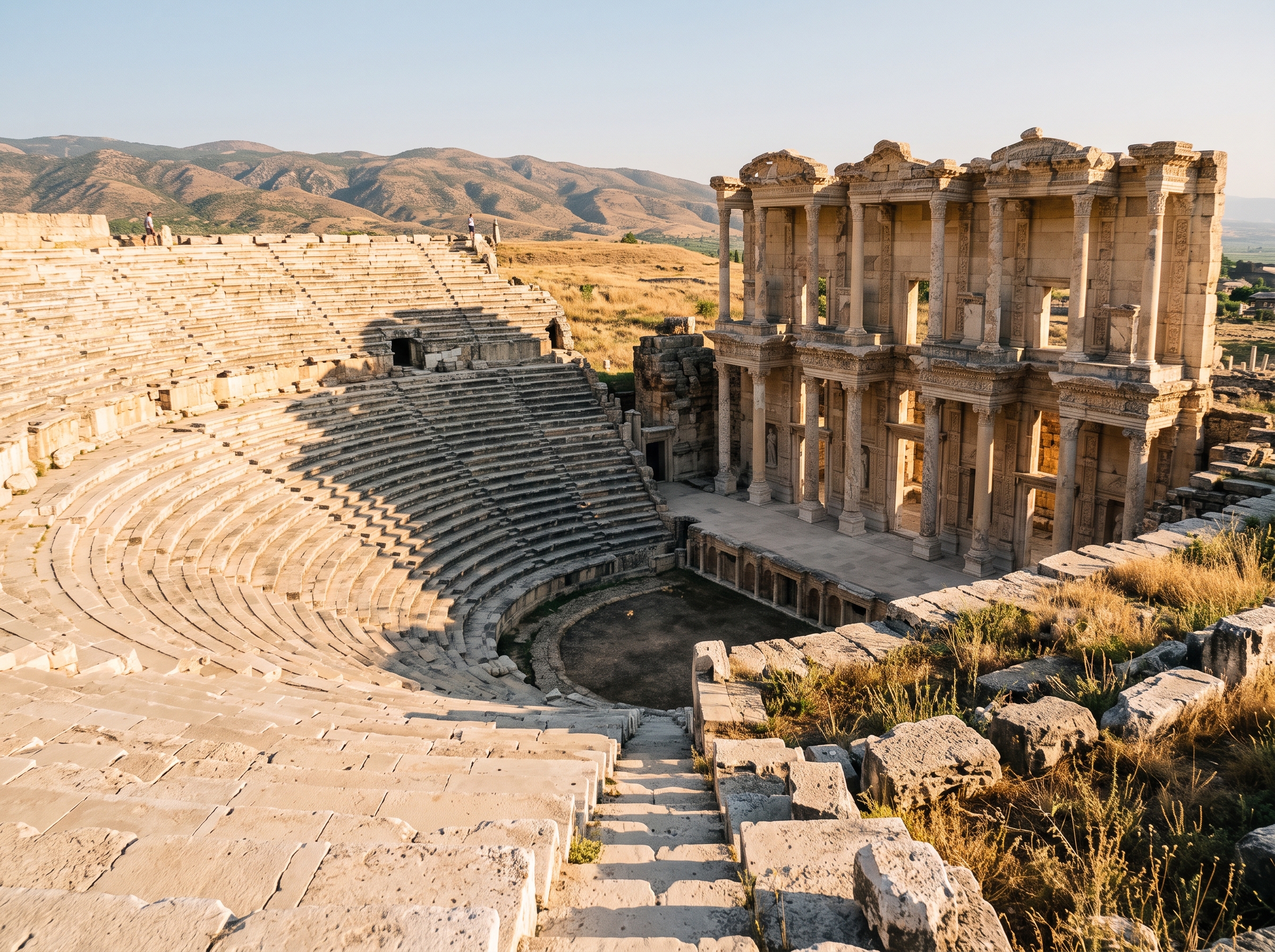
The theatre is the best-preserved structure on the site by a distance, cut into the hillside with its stage building still standing to a serious height. If you see one built thing here, see this.
The necropolis is one of the largest ancient cemeteries in Anatolia, stretching along the approach in tomb after tomb of varying shape and ambition. It is strange and quiet, and most people walk straight past it on their way to the terraces.
The Ancient Pool is thermal water among fallen marble columns, reopened after restoration in 2026. This is the one place on the site where you genuinely swim, since the terraces are ankle-to-knee wading and nothing more. It works best as the middle of your day rather than the end of it.
There is also the Plutonium, the gap in the rock that ancient writers described as an entrance to the underworld and that still vents gas. It is small, and it is more interesting once you know what you are looking at than it is to look at.
Practical things that change the day
Bring a bag for your shoes, because you carry them for the whole barefoot section and there is nowhere to leave them. Bring more water than feels necessary, and something for your head. The combination of reflected light and open ruins is more tiring than the temperature alone suggests.
Wear something you can walk a ruined city in. People arrive dressed for the terrace photograph and then find themselves on broken ground for hours.
Do not plan anything demanding for the evening. A full day here is a genuinely full day.
If you only have half a day
Do the terraces and the Ancient Pool, and accept that you are skipping the city. That is a legitimate visit and a common one.
But if the choice is between rushing both and doing one well, do one well. The regret people report is rarely about missing a monument. It is that they were standing inside a Roman city the whole time and did not know it.
Seeing the whole site at once
There is one way to understand the geography instantly, and that is from the air. From the ground the terraces read as a staircase and the ruins as a separate place entirely. From above they are obviously one system of springs, spill and city. Flights depend on wind and settle in the calmer parts of the day, so treat it as something the weather offers you rather than something you schedule the day around.