
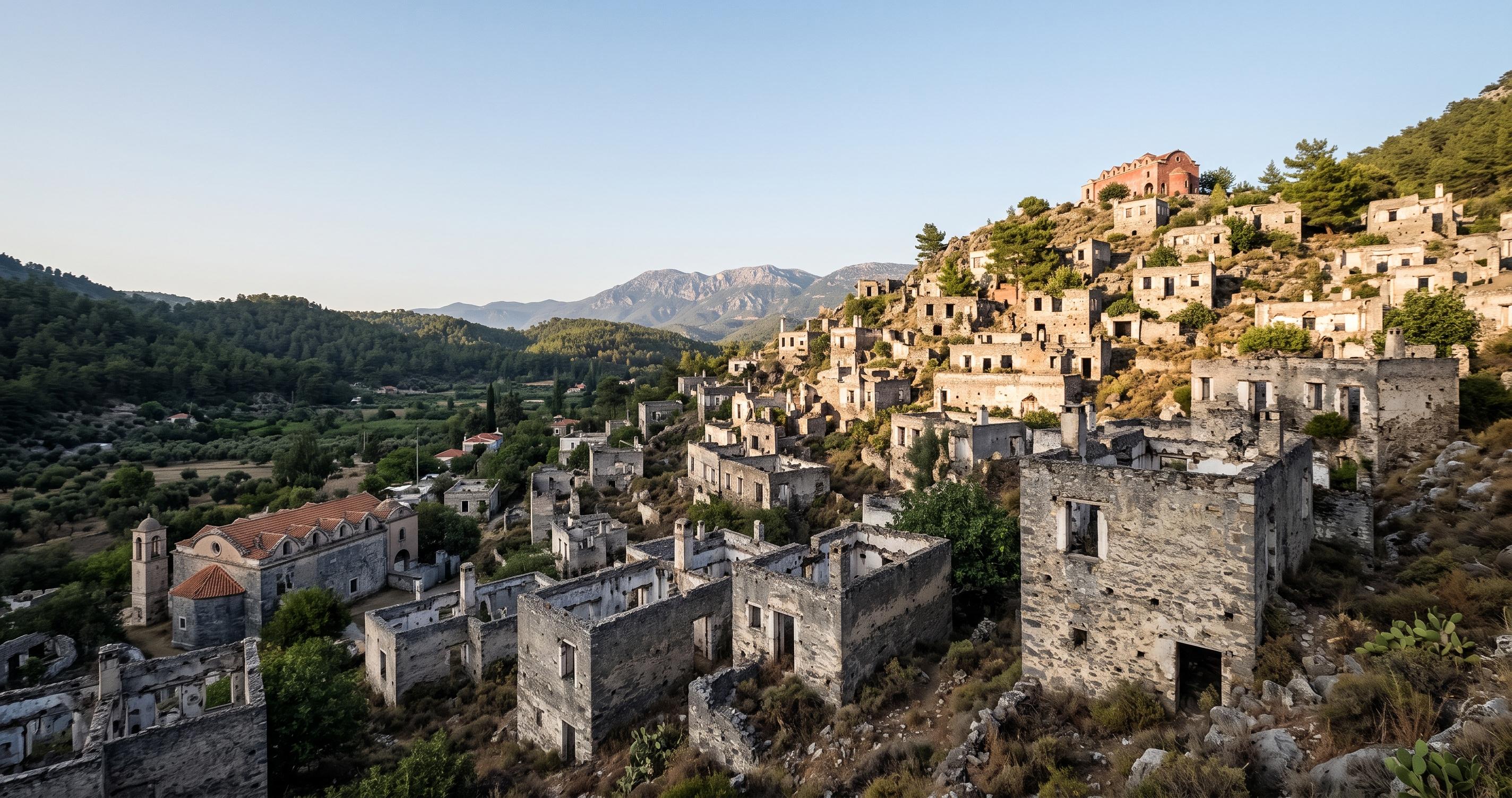
You come round a bend on the road above Fethiye and the hillside is suddenly covered in roofs that aren't there. Hundreds of small stone houses climb the slope in loose rows, walls still standing, window frames still open to the sky, close enough together that from a distance it reads as one grey-gold mass against the hill. Nothing about it looks ancient. It looks paused.
That's the thing that catches people off guard about Kayaköy. Most ruins near the Turkish coast are old enough that the story has worn smooth: an empire fell, centuries passed, and what's left is scenery. Kayaköy is not that. This was a working village, called Livissi by the Greek Orthodox families who lived here, until 1923.
What actually happened here
After the war between Greece and Turkey, the two countries agreed to a population exchange: Greek Orthodox Christians in Turkey would move to Greece, and Muslims in Greece would move to Turkey, sorted by religion rather than by the language they spoke or the place they called home. Livissi's residents, several thousand of them, left for Greece. Under the same agreement, Muslim families arriving from Greece were meant to resettle the empty houses.
Most of them didn't stay. The land around Kayaköy is hillside and stone, harder to farm than the plain closer to Fethiye, and the families who arrived largely moved on to easier ground near the coast. So the houses just stood there, and a century of earthquakes and scavenged roof timber did the rest. But the decay is the slow part of the story. The emptying itself took a single year, and nobody came to fill the village again.
Worth sitting with that before treating the place as a backdrop. Ghost village is the easy label, and it does the history no favours. This was a forced displacement that broke up a real community, and the same exchange emptied Muslim villages on the other side of the Aegean in the reverse direction. Neither side chose to leave.
Walking through it
The houses are close together and built from the same pale stone as the hill, so from a distance the village nearly disappears into the landscape. Up close it separates back out into individual homes: door frames without doors, a few floor tiles still in place, chimneys standing alone where a whole wall has gone. Two churches sit near the top of the site, larger and more ornate than the houses around them, with fragments of painted plaster still clinging to a few interior walls. Guides describe roughly a couple of thousand structures across the hillside. Nobody arriving on foot is counting, and the figures vary anyway, depending on which buildings were still up the last time somebody tried.

Walking here feels different from walking through an ancient site. At Ephesus or Hierapolis you're looking at architecture from a civilization so distant that the loss is abstract. At Kayaköy the scale is domestic: a doorway you'd walk through, a hearth someone cooked at, within reach of living memory when the population exchange happened. That's why it doesn't sit in the memory like a two-line stop on a longer list of attractions.

The ground is loose stone and uneven rubble the whole way up, so proper shoes matter more here than at almost anywhere else on a typical Fethiye itinerary. Give it real time rather than a quick photo stop. There's more site than it looks like from the road, and the upper rows, past where most day-trippers turn back, are quieter and often better preserved.
Whether it's worth the detour
If your Fethiye trip is built around the beach and the Blue Lagoon, Kayaköy asks you to give up part of a day for something with no water and no view of the coast. It rewards that trade if you're already drawn to the region's inland side, or pairing it with a day at Saklıkent Gorge or a jeep safari that heads the same direction out of town. It's a natural half-day addition rather than a destination to build a whole trip around.
The village has also appeared in a few film productions. That's a footnote worth knowing rather than a reason to go. What holds up is the place itself, and the fact that you can put a date on why it emptied.
Come back down the same road you came up on, and the hillside looks different than it did on the way in. It isn't scenery anymore. It's a decision two governments made, and several thousand people who packed up and never came back.