
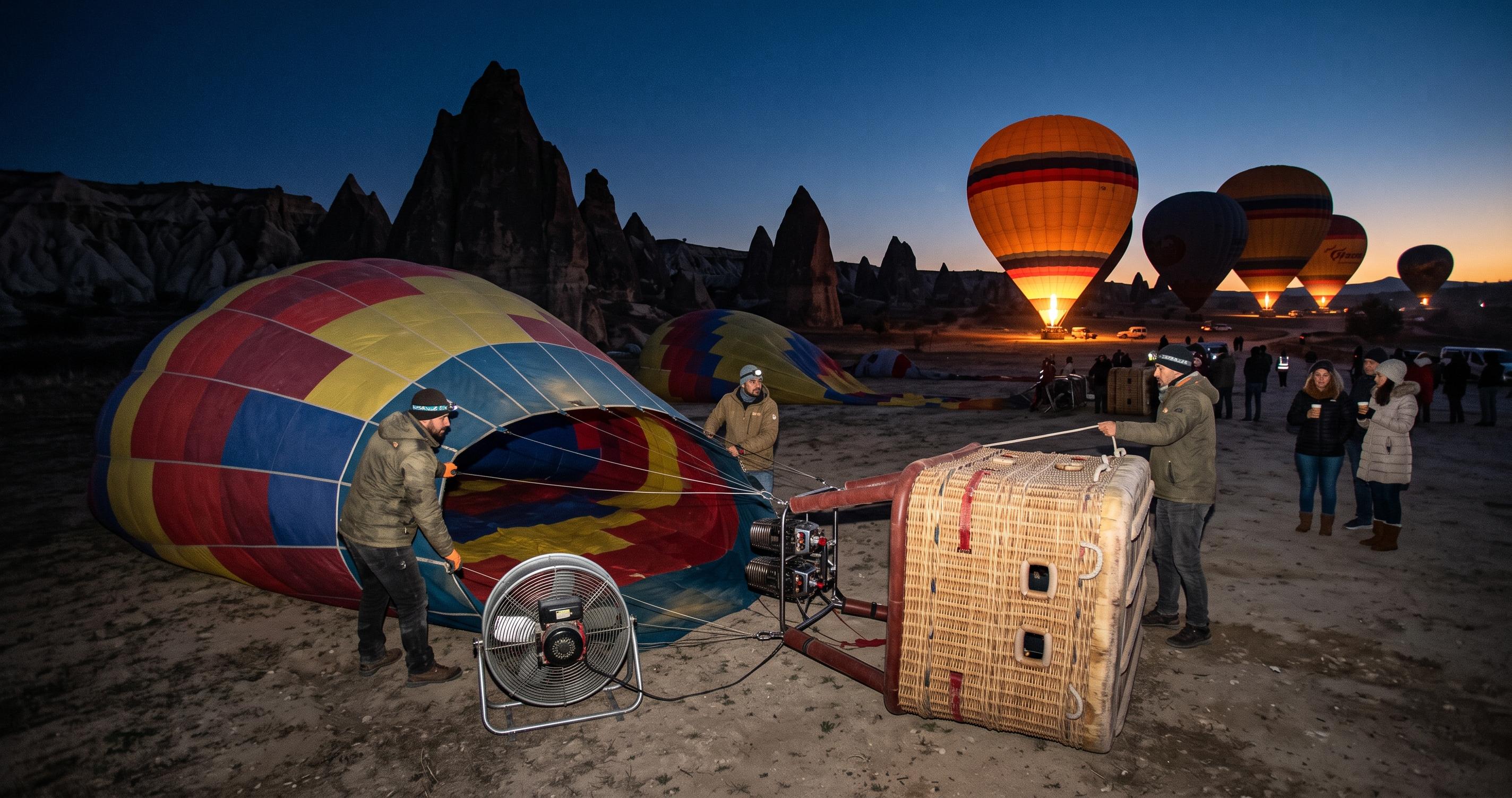
The envelope comes out of the trailer folded like a parachute and gets dragged across the field in the dark by four people who have done it a thousand times. Then a fan the size of a small aircraft propeller starts pushing cold air into the mouth of it, and the thing begins to fill sideways, lying on its side, swelling across the ground, far bigger than it looked in any photograph. Only when it is nearly full does the pilot fire the burner into the opening, the air inside warms, and the whole envelope rolls upright and lifts the basket off its side with a lurch.
Everyone standing around goes quiet at that point. It is the best twenty seconds of the morning and almost nobody arrives expecting it.
The one thing to understand before you book
You are not going for a flight. You are going for a drift.
A balloon has a burner and a vent and nothing else. It has no engine, no rudder and no way to turn. It goes wherever the air at its current height is going, and the only control the pilot has is choosing which height to be at, climbing or sinking until the balloon finds a layer of air moving the way they want.
That single fact explains everything else about the morning. It explains the pre-dawn start, because the air near the ground is calmest and most predictable before the sun starts heating it. It explains why flights get cancelled so readily. It explains why no two flights follow the same line over the same valleys, and why the pilot cannot promise you will pass over any particular one. And it explains the landing, which is less a manoeuvre than a negotiation between the pilot, the wind and a crew driving around the valleys trying to work out where you will come down.
Read it as sailing rather than flying and the whole thing makes sense.
How the morning actually goes
It starts painfully early and in the cold. Cappadocia sits high on the Anatolian plateau, and even in the middle of summer the hour before sunrise is cold enough to want a jacket you did not think to pack. Pickup is from your hotel in the dark, in a minibus doing a circuit of Göreme, Uçhisar, Ürgüp or Avanos.
At the launch site there is usually tea, coffee and something light to eat while the crews work. It is worth walking around during this part rather than waiting in the bus. Several operators inflate in the same field, so you get to watch the whole sequence repeated across the ground at different stages: envelopes flat, envelopes filling, envelopes standing.
Boarding is a climb, not a step. The basket walls come up to around chest height, there are foot holes cut into the side, and you get yourself over the edge with whatever dignity you can manage. Then the pilot briefs the group on the landing position, which matters more than it sounds like it does. That part is below.
The take-off is the surprise. There is no run, no acceleration, no sensation of leaving. The ground just stops being attached to you. Because you are travelling with the air rather than through it, there is no wind in the basket at all, and the flame overhead is the only sound. It is also off far more than it is on. Between bursts it is genuinely silent up there, silent enough to hear a dog somewhere below and other pilots talking across the valley.
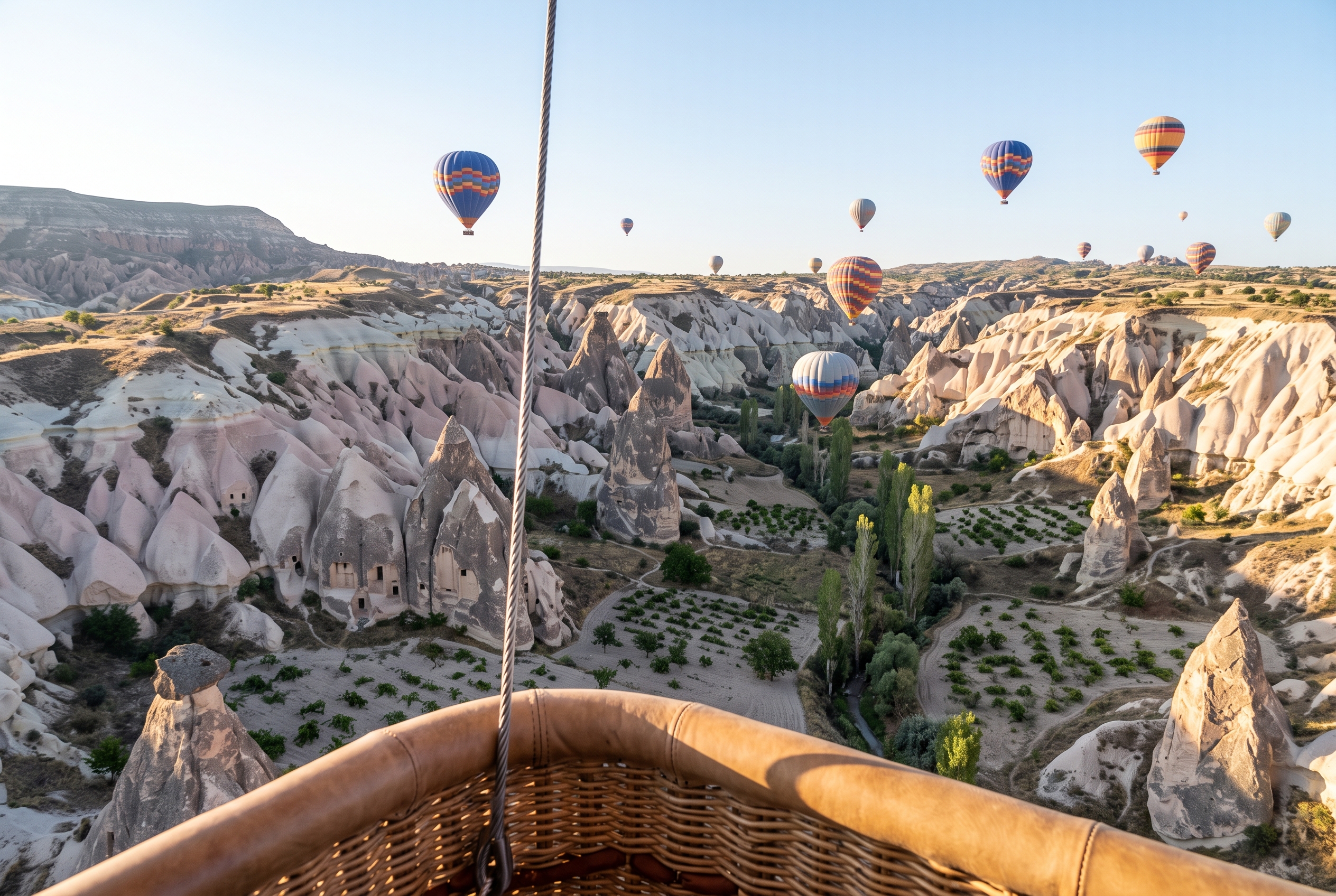
The flight itself works in two registers. Low, the pilot brings the balloon down between the rock formations and along valley floors close enough to see the cut doorways in the cliffs. High, it becomes a landscape: the whole plateau, the cones throwing long shadows, and dozens of other balloons stacked at different heights around you, all of them lit from inside every time someone fires a burner.
The landing
The landing deserves its own warning because it is the part that catches people out.
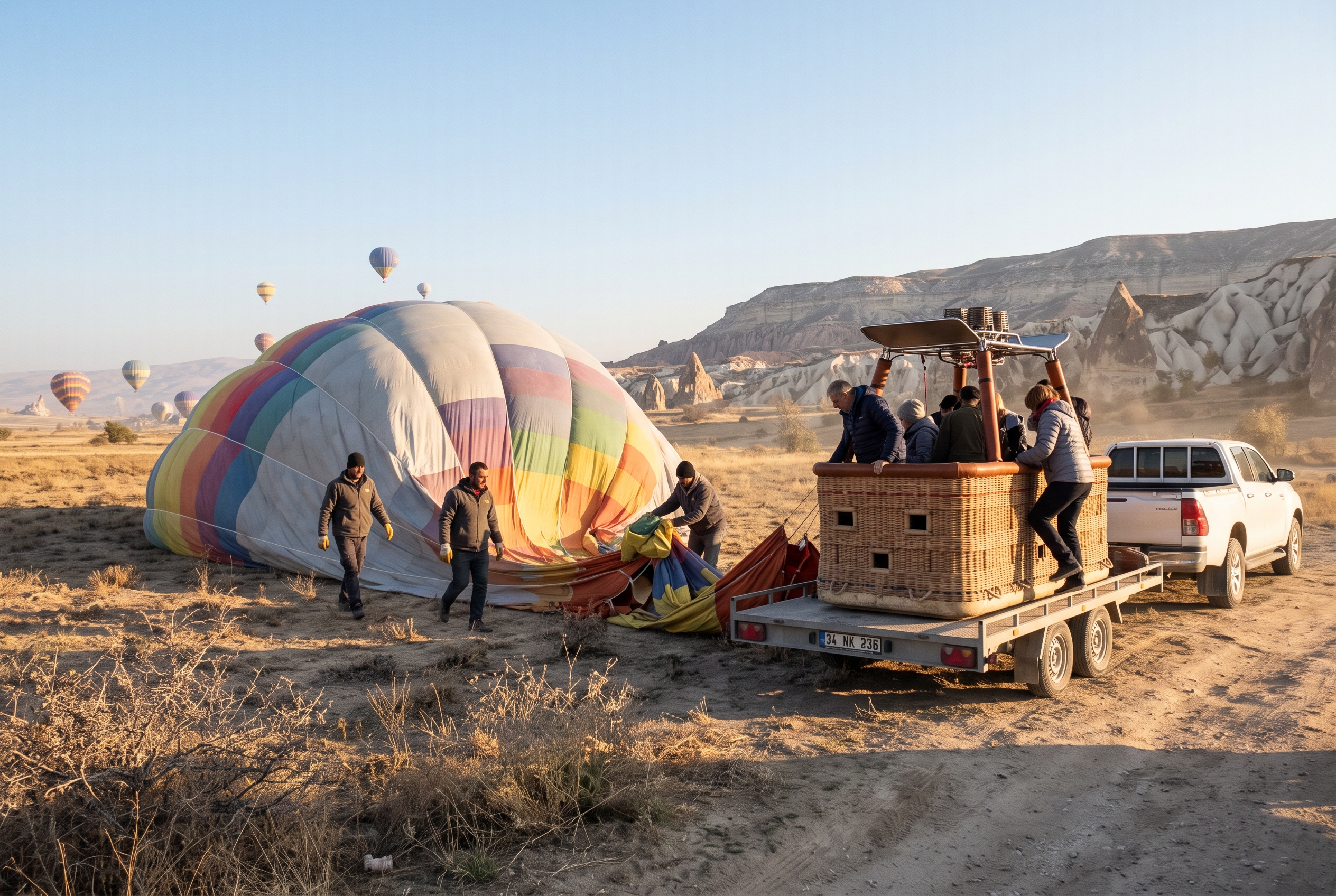
If conditions allow, the crew drives a trailer to wherever the balloon is coming down and the pilot sets the basket directly onto it, which looks impossible and mostly works. Otherwise you land in a field, and depending on the surface wind the basket may touch, drag a little, and tip.
None of that is a failure. It is a normal landing, and it is why the pilot makes everyone practise the landing position: facing the direction of travel, knees bent, both hands gripping the rope handles inside the basket, no cameras out. Do it properly and a firm landing is a jolt. Do it while filming and it is how people get hurt.
Standard basket or the smaller one
Most operators sell at least two classes, and the difference is worth understanding because the marketing language obscures it.
What changes is space and group size. A large shared basket is divided into compartments and carries a lot of people; a small basket carries far fewer, so you have room to move around the edge, change sides during the flight and take photographs without someone's elbow in the frame. Flight length sometimes differs too.
What does not change is the thing you came for. The route, the landscape, the light and the altitude are the same. The sunrise does not know which basket you are in. If your budget is tight, the large basket is not a lesser version of the experience. It is the same flight with less elbow room.
What to wear
Dress for standing in a cold field, not for being in the air. Layers you can take off, closed shoes you can climb in and do not mind getting dusty, and something for your head if you are prone to feeling the cold. The burner puts out real heat directly overhead, so the top of your head and your scalp can feel warm while your hands are still freezing.
Leave loose hats and scarves in your bag during the flight, keep the camera strap round your neck, and put everything away before the landing brief.
Fitting it into the trip
Two pieces of planning advice, and they matter more than which operator you choose.
Book the flight for the first suitable morning of your stay, not the last. Weather grounds flights regularly, and a flight booked for your final morning has no second chance behind it. How the odds shift across the year, and what happens when a morning is called off, is set out in will the balloon actually fly.
And do not build the whole trip around it. Cappadocia is a good destination on the days you do not fly, which is the argument of our wider guide to the region. Treat the flight as the best possible morning rather than the only reason you came, and a cancellation stops being a disaster.
Back on the ground the crew is already packing, squeezing the air out of the envelope by walking down its length, and the field is emptying. It is barely breakfast time. You will be tired by mid-afternoon and it will still have been worth the alarm.